Leave-one-out influence of surveys, cruises or hauls on an sdmTMB index
Source:R/leave-out.R
sdmTMB_leave_out.RdRefits a fitted sdmTMB::sdmTMB() model once for each identifier in ids
with all rows of that identifier removed, and compares the resulting index
with the index of a refit to all data. The identifier can be a survey
series (which survey carries the signal of a compiled index?), a cruise, or
a single haul (which hauls drive an annual index value?).
Each refit reuses the full model's mesh and every setting of its original
call (as sdmTMB::update.sdmTMB() does; formula, family, random fields,
offset, weights, priors, ...), so only the data change. By default the full
model's parameter estimates are used as starting values (falling back to a
cold start if the warm-started fit fails).
Removing an identifier can leave years without data, for example when a
survey series was the only one sampled in some years. These years are
kept in the refit as extra_time, so that the random fields stay defined
and the warm start remains valid, and their index values are reported as
NA. A formula with a factor year effect cannot be estimated for such
years; use a smooth or random-field-only temporal structure, or expect
those refits to fail. Likewise, if newdata predicts for a level of a
factor in the formula (e.g. cruiseseries = "SeriesA"), that level cannot
be left out.
Usage
sdmTMB_leave_out(
  object,
  ids = NULL,
  id_col,
  newdata,
  area = 1,
  index = c("plugin", "split"),
  nsplit = NULL,
  bias_correct = FALSE,
  level = 0.95,
  warm_start = TRUE,
  n_workers = 1,
  future_seed = TRUE,
  verbose = TRUE
)
Arguments
- object
A fitted
sdmTMB::sdmTMB()model. Its offset, if any, is taken fromobject$offset.- ids
Values of
object$data[[id_col]]to leave out one at a time. IfNULL(default), every unique value.- id_col
Name of the identifier column in
object$data, e.g."cruiseseries", a cruise column or a haul identifier.- newdata
Prediction grid with the predictors of the fitted model and its time column.
- area
Grid cell area: a single value, a column name in
newdata, or a numeric vector with one value per row ofnewdata.- index
Character.
"plugin"(default) sums the response-scale grid predictions timesarea, which is fast and suits screening many identifiers (e.g. hauls);"split"usessdmTMB::get_index_split()and returns standard errors and confidence intervals, which suits a few identifiers (e.g. survey series).- nsplit, bias_correct, level
Passed to
sdmTMB::get_index_split()whenindex = "split".- warm_start
Logical. Use the full model's estimates as starting values? Default
TRUE.- n_workers
Integer. Number of parallel workers. Default
1, which uses whateverfuture::plan()is currently set. Values> 1set a temporary parallel plan (forkedfuture::multicorewhere supported, otherwisefuture::multisession).- future_seed
Logical or integer. Future-compatible random seed.
- verbose
Logical. Show progress messages (via cli when installed)? Default
TRUE.
Value
An object of class sdmTMB_leave_out, a list with
full: the index of the refit to all data, by year;index: the index of each leave-out refit by year, with columnsid,year,est(andlwr,upr,seforindex = "split"),ratio(estdivided by the full index) andremoved(TRUEfor years with no data left after removingid, whereestisNA);influence: one row per identifier with the number of rows removed, the years it has data in (id_years),haul_share(its share of the rows in those years),influence(one minus the geometric mean ratio over those years, so positive when the identifier raises the index),leverage(influence / haul_share),max_abs_changeandyear_max_change(the largest absolute relative change over all years) andall_ok(whether the refit passedsdmTMB::sanity()).
Influence and leverage
A large influence on its own mostly flags the main survey of a year: if a
cruise supplied 60 % of a year's hauls, removing it is expected to move the
index. leverage scales the influence by the identifier's share of the
hauls, so a value well above 1 marks an identifier that moves the index far
more than its sample size warrants, typically a one-off or auxiliary cruise
that sampled a high-density area few other cruises cover. A practical screen
is influence >= 0.1 & leverage >= 2; see plot(x, type = "leverage").
Screen candidates cheaply first with density_share().
Examples
# \donttest{
data(sebastes)
sub <- subset(sebastes, cruiseseries %in% c("EcoS", "WinterS", "EggaN") &
year >= 2018)
mesh <- sdmTMB::make_mesh(sub, c("X", "Y"), cutoff = 60)
fit <- sdmTMB::sdmTMB(
biomass ~ 1, data = sub, time = "year", mesh = mesh,
family = sdmTMB::tweedie(), spatiotemporal = "ar1",
offset = log(sub$swept_area)
)
region <- make_survey_prediction_region(sub, crs = 32633)
grid <- sdmTMB::replicate_df(
make_prediction_grid(region, resolution = 30), "year", unique(sub$year)
)
lo <- sdmTMB_leave_out(
fit, id_col = "cruiseseries", newdata = grid, area = (30 / 1.852)^2
)
#> ⠙ Refitting the full model
#> ✔ Refitting the full model [4ms]
#>
#> ⠙ Refitting without each of 3 identifiers
#> ✔ Refitting without each of 3 identifiers [4ms]
#>
lo$influence
#> # A tibble: 3 × 9
#> id n_removed id_years haul_share influence leverage max_abs_change
#> <chr> <int> <list> <dbl> <dbl> <dbl> <dbl>
#> 1 WinterS 2677 <int [8]> 0.601 0.661 1.10 0.763
#> 2 EcoS 1379 <int [8]> 0.310 0.384 1.24 0.513
#> 3 EggaN 397 <int [4]> 0.160 0.119 0.741 0.324
#> # ℹ 2 more variables: year_max_change <int>, all_ok <lgl>
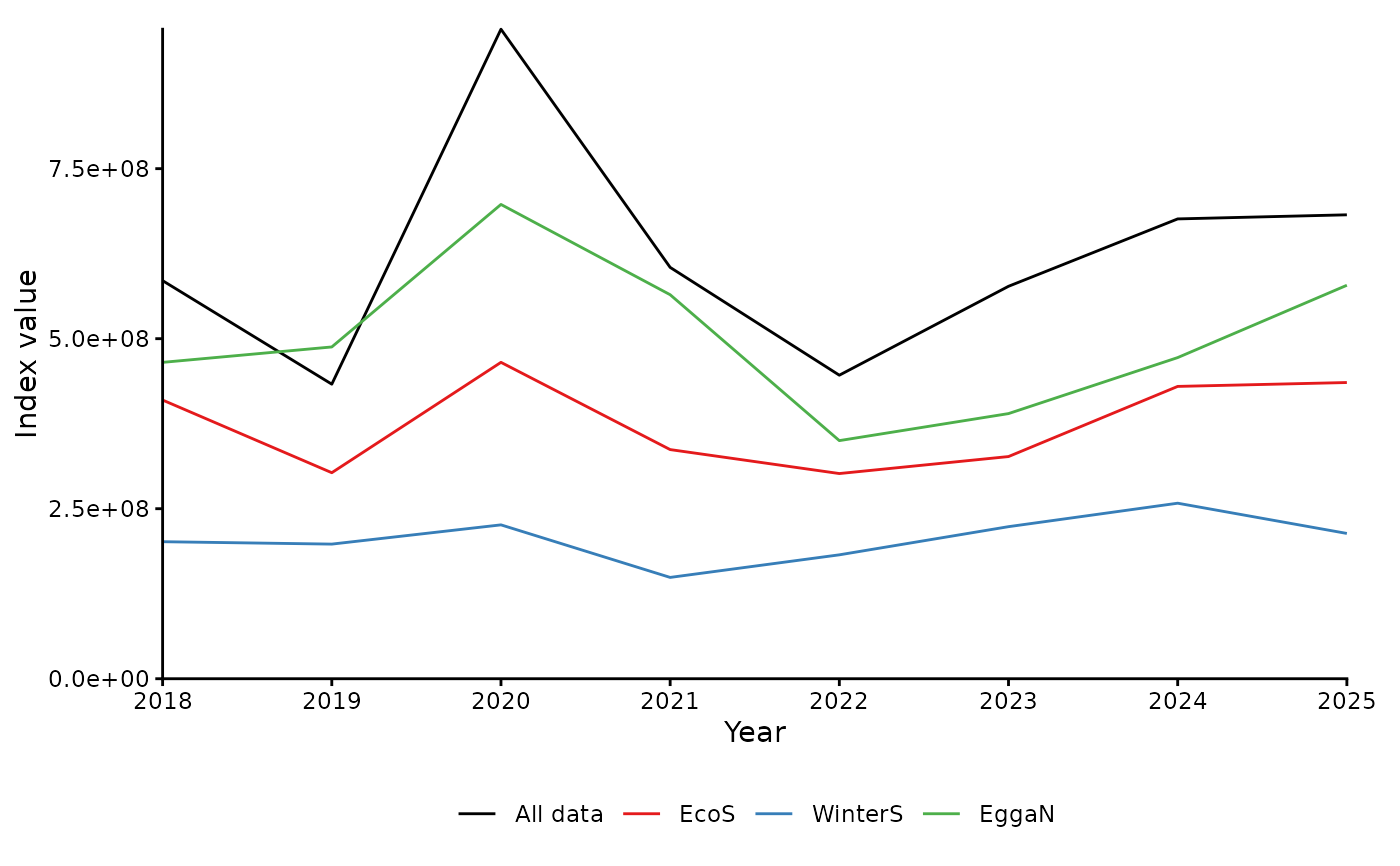
plot(lo)
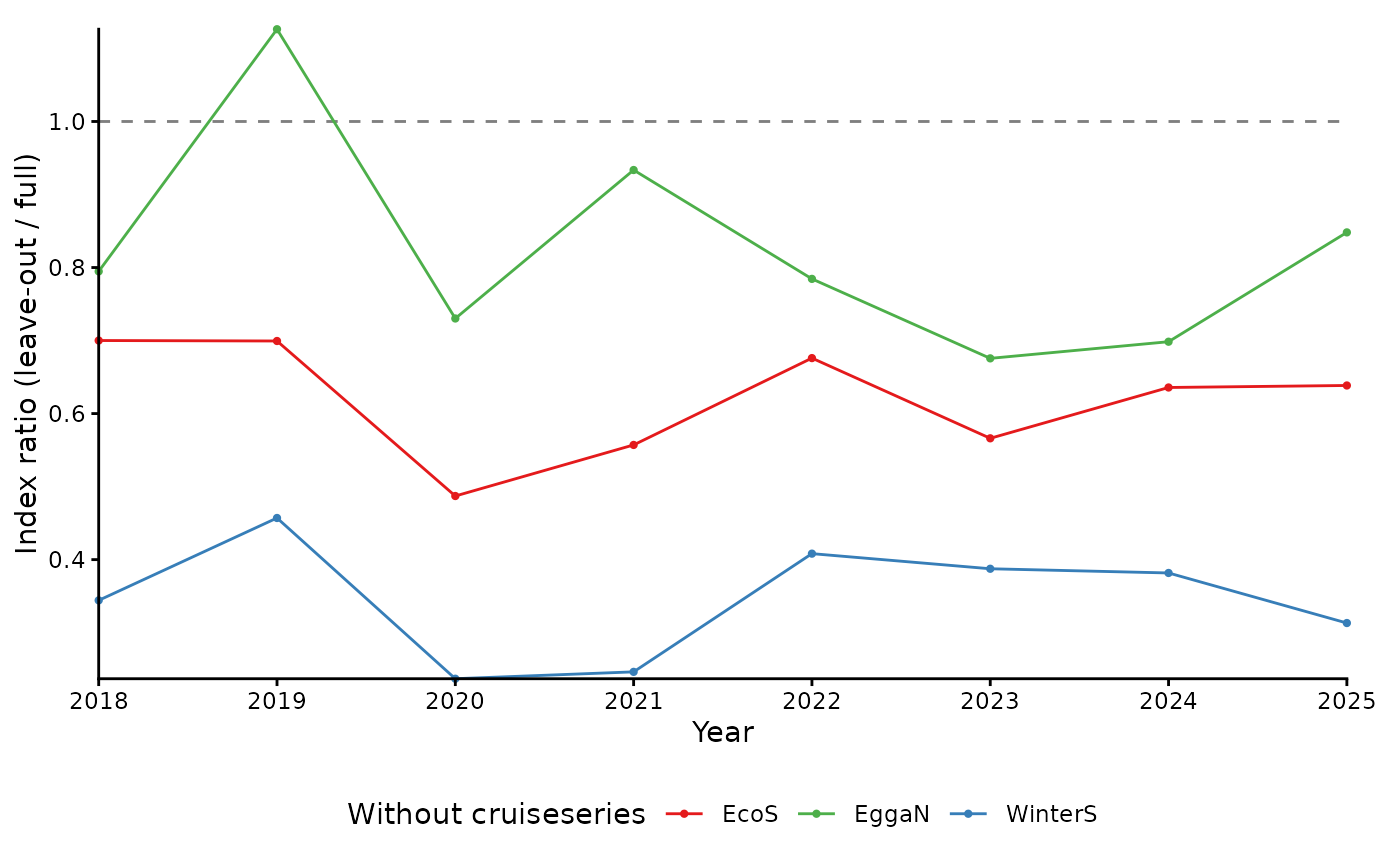
 plot(lo, type = "ratio")
 # }