Runs an analytical retrospective on an index from sdmTMB::sdmTMB(). The
function refits the model for each peel (successively dropping the most recent
years) and calculates an index for each peel using
sdmTMB::get_index_split(). All model settings are inherited from the
original call of the fitted object (as with sdmTMB::update.sdmTMB());
only data and mesh are replaced. Arguments of the original call are
evaluated in the environment of the model formula, so objects referenced
there (e.g. priors = my_priors) must still exist.
Usage
sdmTMB_retro(
  object,
  newdata,
  nyears = 5,
  refit_meshes = FALSE,
  cutoff = NULL,
  bias_correct = FALSE,
  level = 0.95,
  area = 1,
  save_models = FALSE,
  silent = TRUE,
  n_workers = 1,
  nsplit = NULL,
  predict_args = list(),
  future_seed = TRUE
)
Arguments
- object
A fitted model from
sdmTMB::sdmTMB().- newdata
A data frame to make predictions on, with the same predictor columns as the fitted data and a time column with the same name as in the fitted data. Must contain all years needed for the retrospective (see
nyears).- nyears
Integer. How many peels the retrospective should contain, including the terminal (most recent) year. Clamped to the number of fitted years available.
- refit_meshes
Logical. Rebuild the mesh for each peel from the peeled data using
cutoff? IfFALSE(default) the original model mesh is reused unchanged, including any barrier. Rebuilt meshes have no barrier (a warning is given if the original mesh has one).- cutoff
Numeric. Mesh cutoff (in model coordinate units) used to rebuild the meshes when
refit_meshes = TRUE. Required in that case, since the original cutoff is not stored in the fitted model.- bias_correct
Logical. Apply bias correction via
TMB::sdreport()? RecommendedTRUEfor final analyses,FALSE(default) while experimenting.- level
Numeric. Confidence level for the index intervals.
- area
Grid cell area for area weighting the index. Can be a numeric vector of length
nrow(newdata), a single numeric value, or a character column name innewdata. Passed tosdmTMB::get_index_split().- save_models
Logical. Retain the fitted model object for each peel in the output?
- silent
Logical. Suppress model fitting output?
- n_workers
Integer. Number of parallel workers. Default
1, which uses whateverfuture::plan()is currently set (sequential by default). Values> 1set a temporary parallel plan (forkedfuture::multicorewhere supported, otherwisefuture::multisession).- nsplit
Integer. Number of splits for
sdmTMB::get_index_split().NULL(default) uses about 75 000 grid rows per split, which avoids the silent crashes of bias-corrected extraction on very large grids.- predict_args
A list of extra arguments passed to
sdmTMB::predict.sdmTMB()when calculating each peel's index (thepredict_argsargument ofsdmTMB::get_index_split()), e.g.list(re_form_iid = NA).- future_seed
Logical or integer. Future-compatible random seed for parallel processing. See
future.apply::future_lapply().
Value
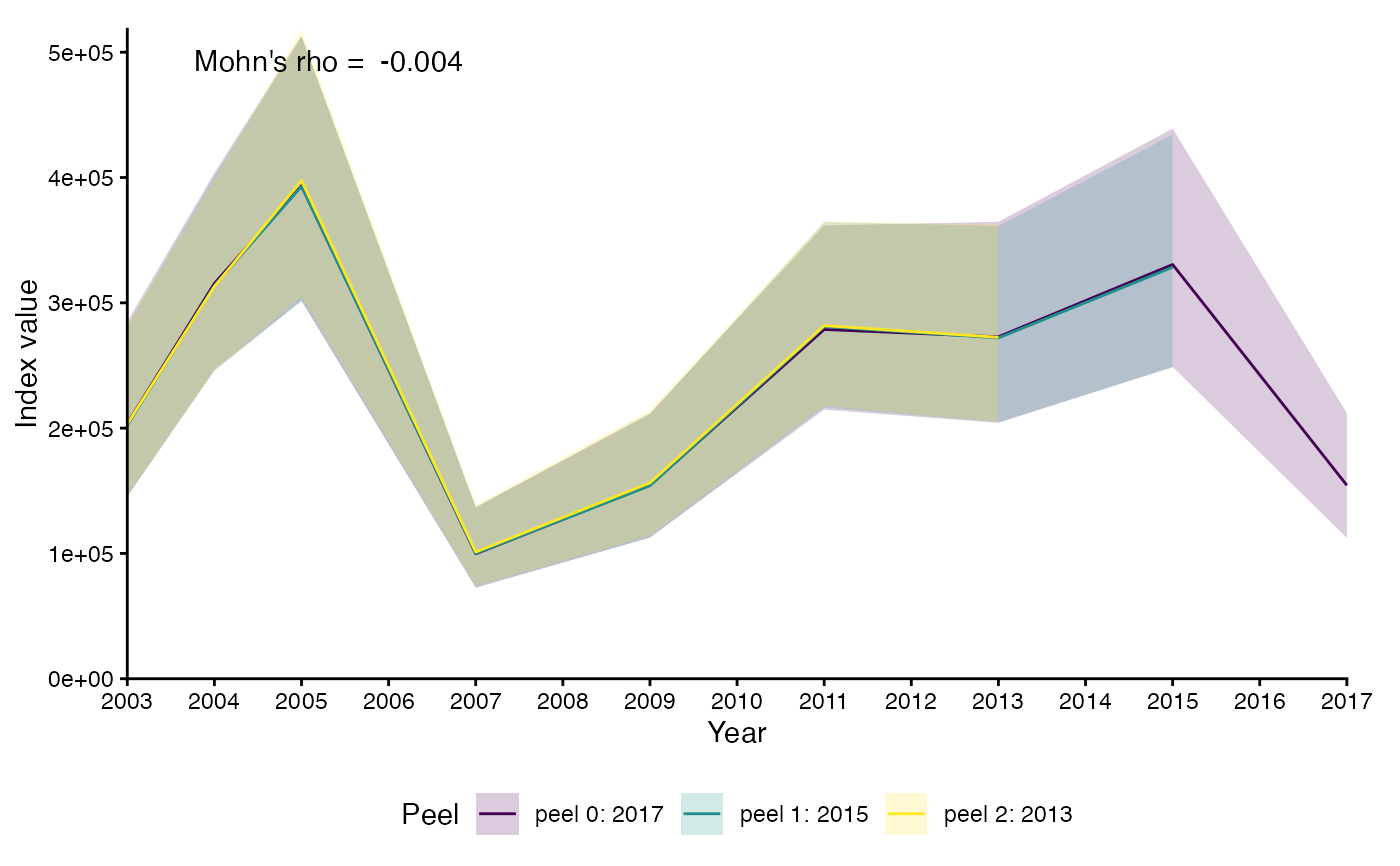
A list of class sdmTMB_retro. Each element corresponds to a peel and
contains an index data frame (and, if save_models = TRUE, the fitted
model object).
Examples
# \donttest{
mesh <- sdmTMB::make_mesh(sdmTMB::pcod, c("X", "Y"), cutoff = 25)
m <- sdmTMB::sdmTMB(
data = sdmTMB::pcod,
formula = density ~ 0 + as.factor(year),
time = "year", mesh = mesh, family = sdmTMB::tweedie(link = "log")
)
nd <- sdmTMB::replicate_df(sdmTMB::qcs_grid, "year", unique(sdmTMB::pcod$year))
retr <- sdmTMB_retro(m, nd, nyears = 3, n_workers = 1)
#> Model for 2017 did not pass sdmTMB::sanity() checks.
#> Model for 2015 did not pass sdmTMB::sanity() checks.
#> Model for 2013 did not pass sdmTMB::sanity() checks.
plot(retr)
 # }