Plots an estimate of length or age at 50% mature for a dataset
Usage
plot_maturity(
  dt,
  length = "length",
  maturity = "maturity",
  sex = "sex",
  split.by.sex = FALSE,
  female.sex = "F",
  male.sex = "M",
  length.unit = "cm",
  length.bin.width = 2,
  bootstrap.n = NA,
  bootstrap.cluster = NULL,
  force.zero.group.length = NA,
  force.zero.group.strength = NA,
  force.zero.group.n = NA,
  force.zero.group.cv = 0,
  xlab = "Total length",
  base_size = 8,
  legend.position = "bottom",
  ...
)
Arguments
- dt
A data.frame, tibble or data.table
- length
Character argument giving the name of the length (or age) column in
dt- maturity
Character argument giving the name of the maturity column in
dt. Should be either logical (TRUE == mature, FALSE == immature) or integer (1 == mature, 0 == immature).- sex
Character argument giving the name of the sex column in
dt. Ignored ifsplit.by.sex == FALSE.- split.by.sex
Logical indicating whether the result should be split by sex.
- female.sex, male.sex
A character or integer denoting female and male sex in the
sexcolumn ofdt, respectively.- length.unit
A character argument giving the unit of
length. Will be used in the labels of the figure.- length.bin.width
Numeric specifying the increment (delta length) by which length data should be binned to calculate maturity proportions. Use
NULLto remove from the plot.- bootstrap.n
Integer defining the number of bootstrap replicates to be used to calculate 95% confidence intervals for the mean 50% mature estimate. If
NA(default), the confidence intervals are calculated from the glm object using the delta method without bootstrapping. See Details.- bootstrap.cluster
Character argument giving the name of a column in
dtthat identifies the sampling unit (e.g. haul, station or trip ID) for a cluster bootstrap. IfNULL(default), individual fish are resampled. If given, whole clusters are resampled with replacement instead, which accounts for fish from the same haul being more alike than fish from different hauls. Requiresbootstrap.n. See Details.- force.zero.group.length
Numeric indicating the length to which 0-group (all immatures) should be forced. Use
NAignore the forcing.- force.zero.group.strength
Numeric indicating how many percent of total fish should be added to the specified
force.zero.group.length. Cannot be used simultaneously withforce.zero.group.n- force.zero.group.n
Numeric indicating how many observations should be added to the specified
force.zero.group.length. Ifsplit.by.sex = TRUE, use a named vector of length two with names referring tofemale.sexandmale.sex. Cannot be used simultaneously withforce.zero.group.strength- force.zero.group.cv
Numeric indicating the coefficient of variation for the forced 0-group (all immature) length. Resulting lengths will be randomly generated from a normal distribution.
- xlab
Character giving the x-axis label without unit
- base_size
Base size parameter for ggplot. See theme.
- legend.position
Position of the ggplot legend as a character. See theme.
- ...
Additional arguments passed to geom_density_ridges.
Value
A named list with plot (a ggplot2 object), text (a text summary),
and params (the estimated maturity-model parameters).
Details
The 95% confidence intervals for the mean 50% mature estimate are calculated by default with the delta method from the fitted glm (see unlogit): L50 = -intercept/slope, and its standard error is approximated from the variance-covariance matrix of the intercept and slope, so the strong negative correlation between the two is accounted for. The interval is L50 \(\pm\) 1.96 SE and is equivalent to MASS::dose.p(). Versions of ggFishPlots before 0.4.5 combined the marginal profile-likelihood limits of the intercept and slope, which ignored this correlation and produced far too wide intervals.
The delta-method interval might not be optimal when zero group fish are added, because the added data inflate the apparent sample size. Hence, the function contains an option to bootstrap confidence intervals using the same number of data than observations (i.e. excluding the added data from the number of randomly resampled rows). Adding an integer to the bootstrap.n argument turns on this feature; the interval is then given by the 2.5% and 97.5% quantiles of the bootstrapped L50 estimates. Without added zero group data, the bootstrapped and delta-method intervals are usually similar.
Both the delta-method and the individual bootstrap intervals assume that fish are independent observations. Survey and fishery samples are usually clustered: fish caught in the same haul tend to be of similar size and maturity, so the effective sample size is smaller than the number of fish and these intervals are too narrow. Giving the haul (or other sampling unit) identifier in bootstrap.cluster turns on a cluster bootstrap: each replicate draws as many clusters as there are in the data, with replacement, and refits the model to all fish in the drawn clusters. Added zero group data are appended unchanged to each replicate. Fish with a missing cluster identifier are removed. The cluster bootstrap needs a reasonable number of clusters (preferably several tens) per sex to be reliable.
Examples
# Simple L50 plot
data(survey_ghl)
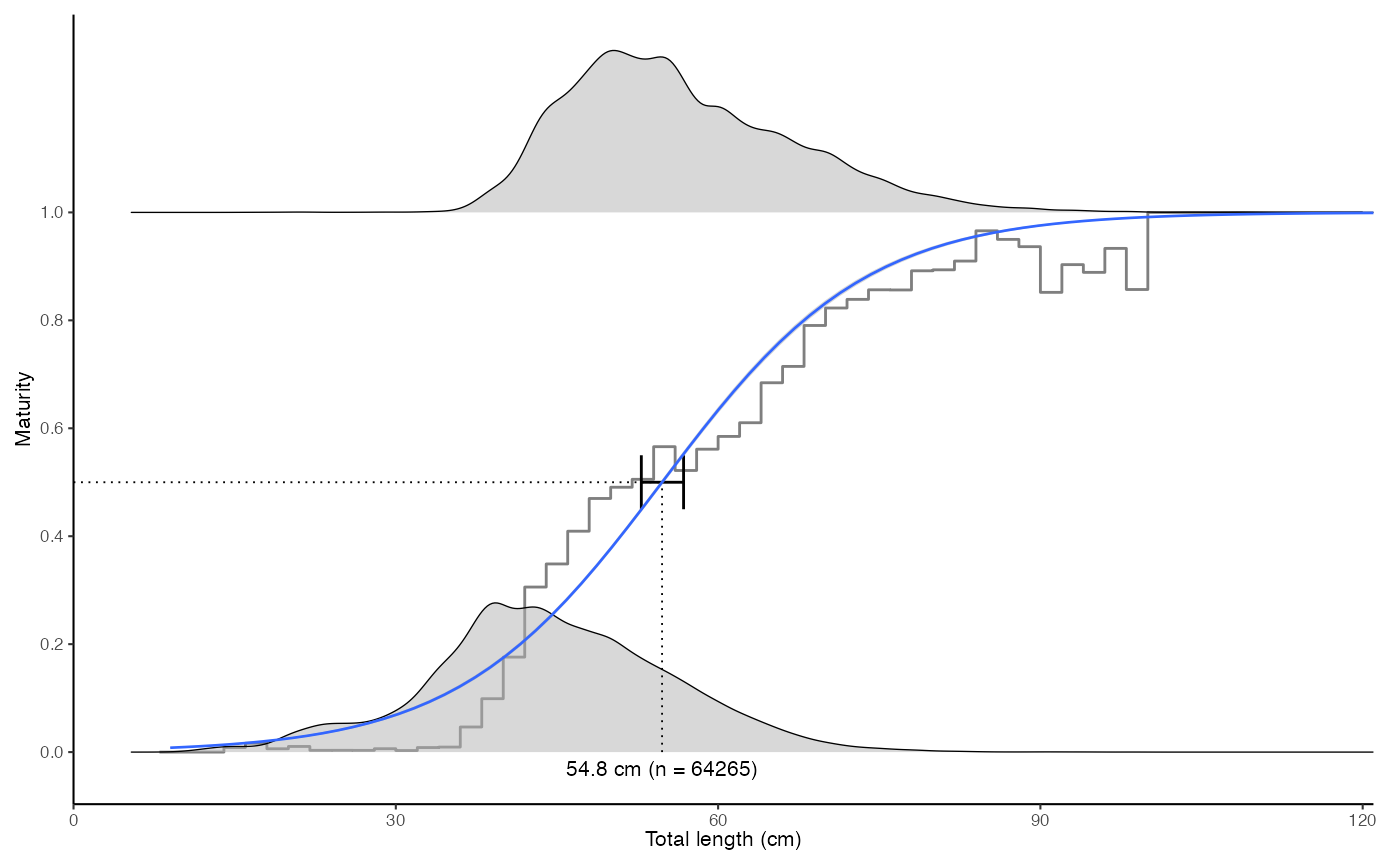
plot_maturity(survey_ghl, length = "length", maturity = "maturity")
#> $plot
#> Picking joint bandwidth of 1.21
 #>
#> $text
#> [1] "50% maturity at length (L50) based on logit regressions:\n54.784 cm. 95% confidence intervals: 54.597 - 54.97\n Number of specimens: 64265.\n Confidence intervals estimated from the glm object using the delta method."
#>
#> $params
#> mean ci.min ci.max sex intercept slope n
#> 1 54.78361 54.5971 54.97013 both -5.755492 0.1050587 64265
#>
# \donttest{
# Bootstrapped CIs
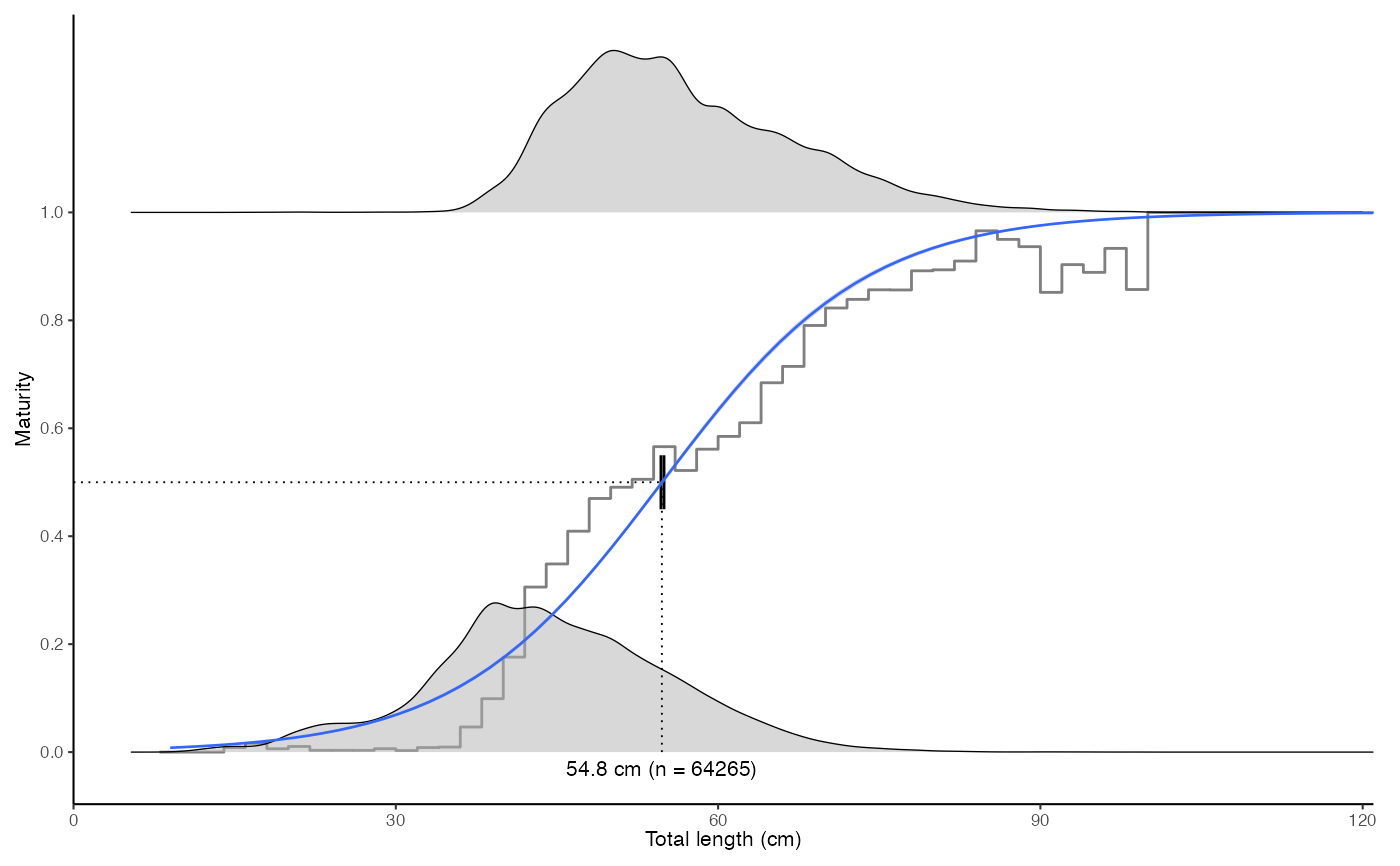
plot_maturity(survey_ghl, bootstrap.n = 10)
#> $plot
#> Picking joint bandwidth of 1.21
 #>
#> $text
#> [1] "50% maturity at length (L50) based on logit regressions:\n54.831 cm. 95% confidence intervals: 54.748 - 54.895\n Number of specimens: 64265\n\n Confidence intervals estimated using 10 bootstrap replicates."
#>
#> $params
#> mean ci.min ci.max sex intercept slope n
#> 1 54.83089 54.74781 54.89468 both -5.755492 0.1050587 64265
#>
# Cluster (haul-level) bootstrap. survey_ghl has no haul ID, so a
# made-up one is used here for illustration only
ghl <- survey_ghl
ghl$haul <- sample(1:50, nrow(ghl), replace = TRUE)
plot_maturity(ghl, bootstrap.n = 10, bootstrap.cluster = "haul")
#> $plot
#> Picking joint bandwidth of 1.21
 #>
#> $text
#> [1] "50% maturity at length (L50) based on logit regressions:\n54.805 cm. 95% confidence intervals: 54.69 - 54.998\n Number of specimens: 64265\n\n Confidence intervals estimated using 10 bootstrap replicates resampling haul clusters."
#>
#> $params
#> mean ci.min ci.max sex intercept slope n
#> 1 54.80499 54.69015 54.99832 both -5.755492 0.1050587 64265
#>
# A50 plot, split by sex
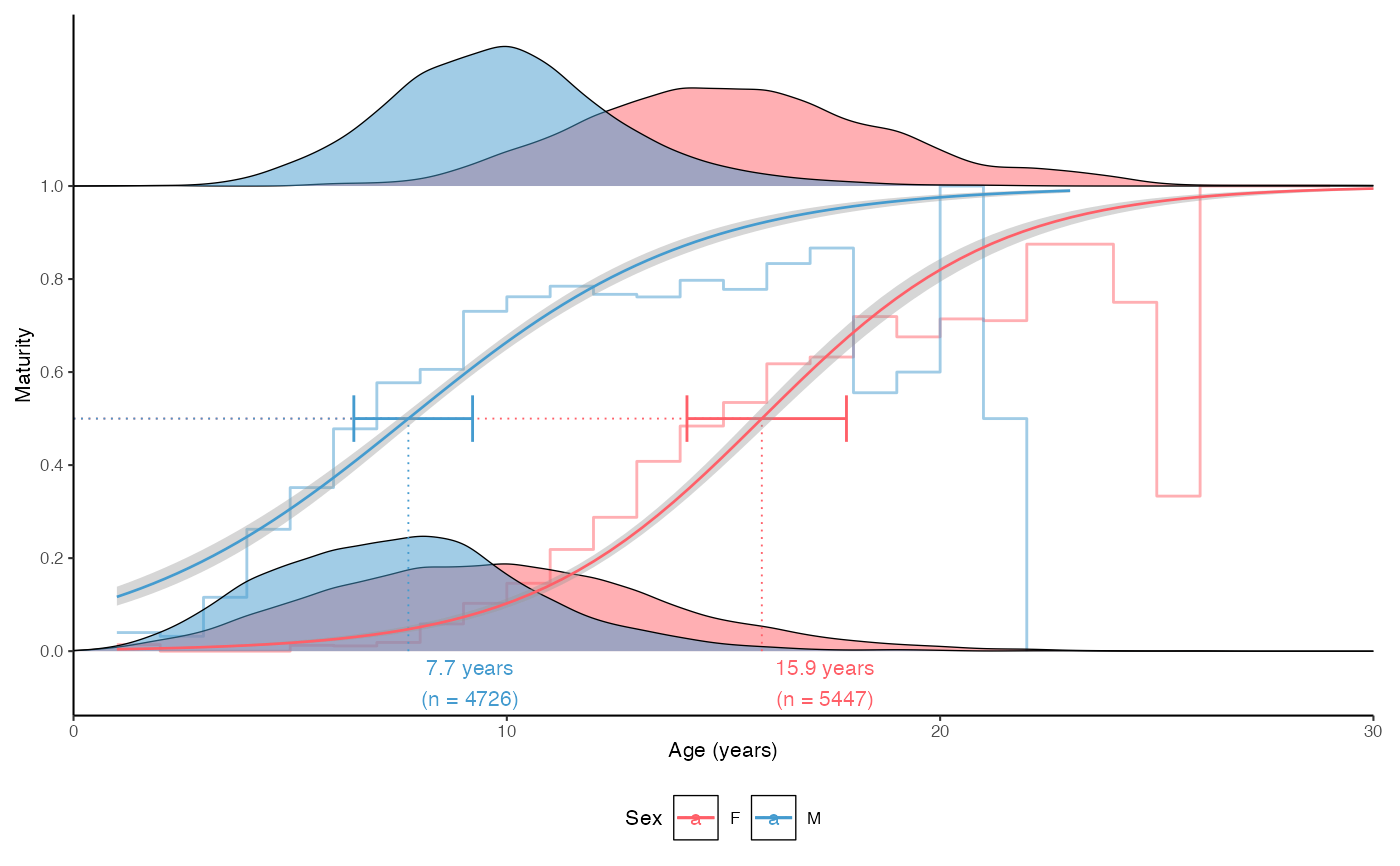
plot_maturity(survey_ghl, length = "age", length.unit = "years",
xlab = "Age", length.bin.width = 1, split.by.sex = TRUE)$plot
#> Picking joint bandwidth of 0.602
 # Add juveniles
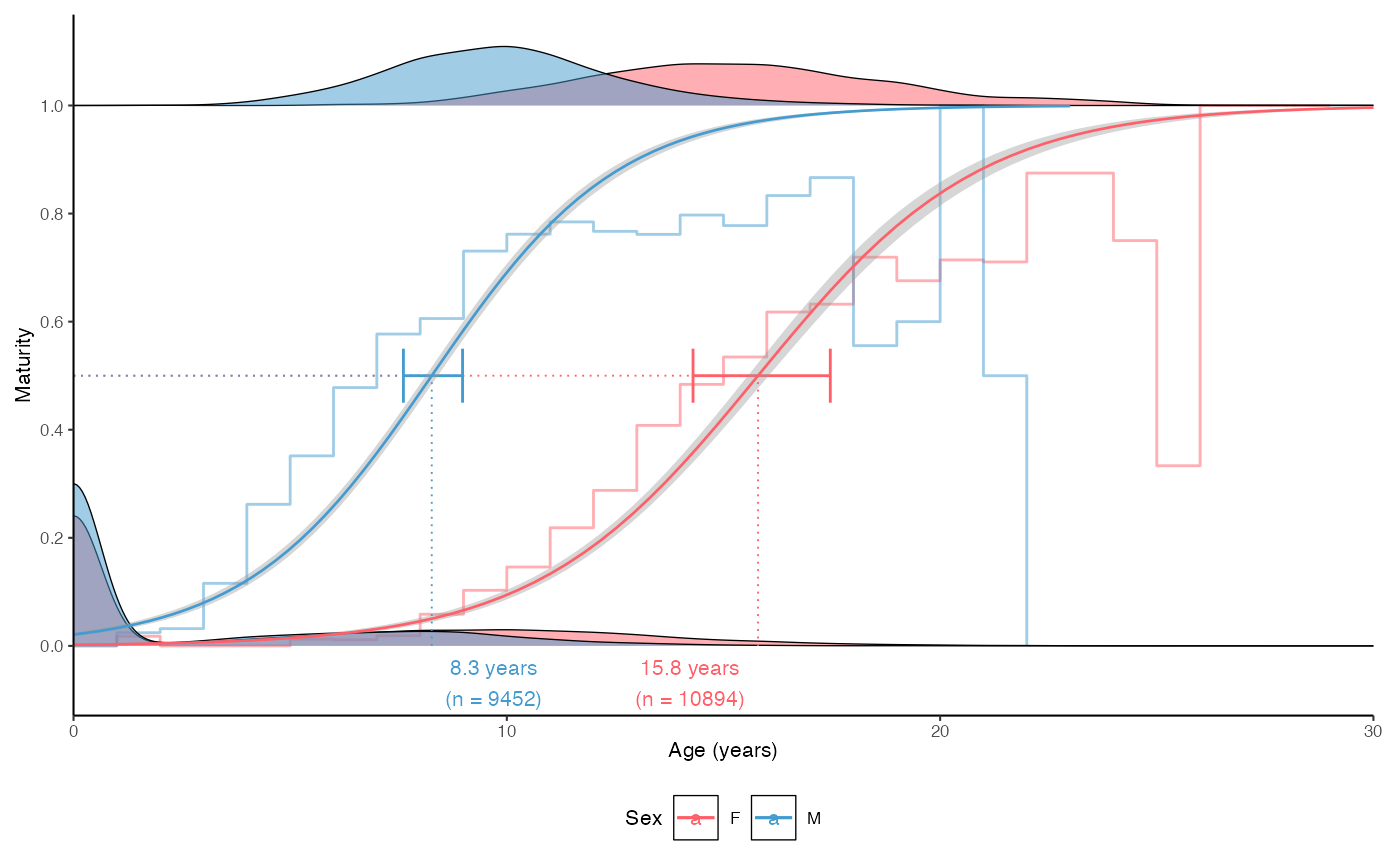
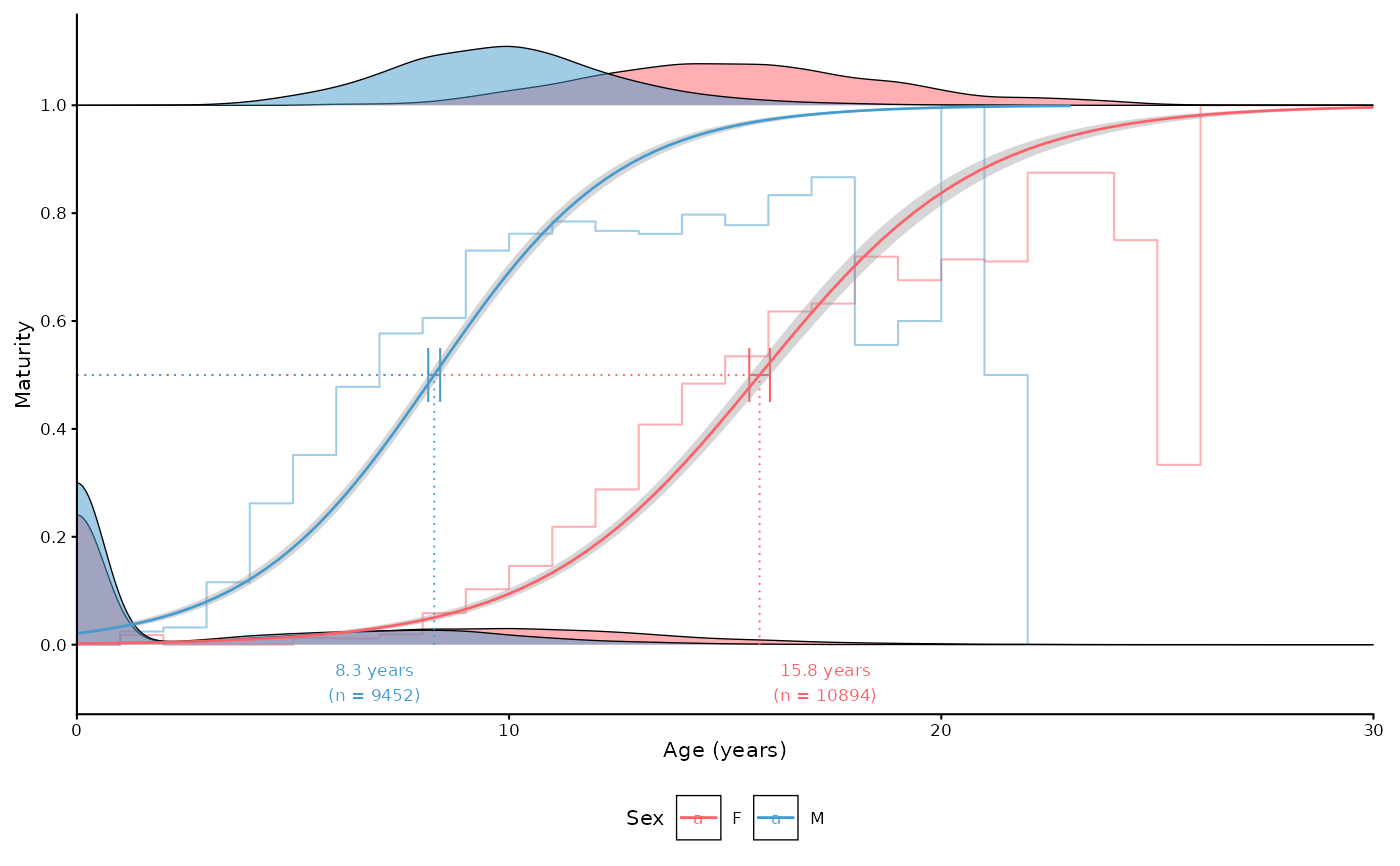
plot_maturity(survey_ghl, length = "age", length.unit = "years",
xlab = "Age", length.bin.width = 1, split.by.sex = TRUE,
force.zero.group.length = 0,
force.zero.group.strength = 100)$plot
#> Picking joint bandwidth of 0.638
 # }